Shopping cart 0 items
Subscribe
Donate
Member Login
Student Login

Search form

Share
Login
Home
  • About
    • Mission
    • History
    • Masthead
    • Board of Directors
    • Contact
    • Privacy Notice
    • FAQ
    • Internships
  • Articles
    • Current Articles
    • Collections
      • Interviews
      • Narrative
      • History
      • Technology
      • Criticism
      • Other
    • Print Archive
    • Write for SP
  • Announcements
    • General
    • Classified
    • Events
    • Newsletter
  • Membership
  • Grants for Apprenticeships
  • Donate
    • Underwriting
    • Donate
    • Partners
  • Store
Simone Leigh, "Jug," 2014. Photo courtesy Tilton Gallery, New York.

Evidence of Things Unseen

Chenoa Baker

Slab works made by my mom in college, David MacDonald’s work that my parents acquired, and clay in liturgical metaphors were my first encounters with clay. All of these childhood references instilled the knowledge that clay starts out amorphous but can be shaped and molded by a hand and possibly added tools. It needs to be acted upon in order to reveal its beauty. As a twentysomething Boston transplant, my first full-time job was as a museum fellow at the Institute of Contemporary Art, Boston. My work there centered on a solo show of Simone Leigh’s work (opening April 6, 2023) and her presentation at the Venice Biennale in 2022. From there, I took a wheel-throwing class at Harvard University to understand more about Leigh’s medium and her use of the vessel for how she cites unrecognized feminized and racialized labor.
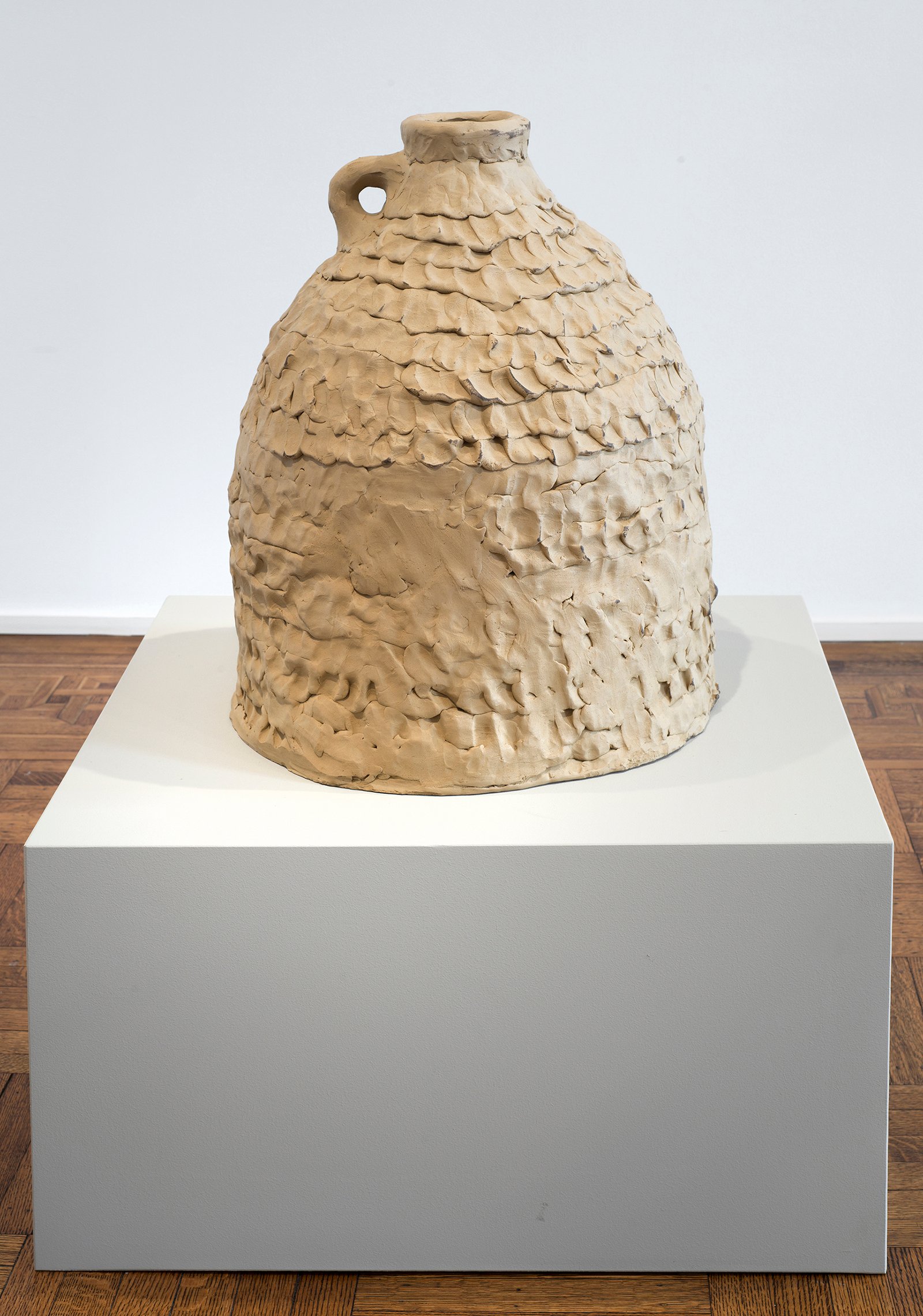
What I learned while centering the clay and obsessing over the clay-to-water ratio in class for weeks is that clay particles are like platelets; water and earth dance around and are compressed in the process of sculpting. While the goal is cohesion, it starts as a suspension. White supremacist capitalist patriarchy, not to oversimplify it, is in suspension, as it is multiple different ideologies pulling apart rather than binding together. I learned this profound lesson from Simone Leigh’s "Jug" (2014). As an outlier in her practice, because it is unfired and has a much subtler nod to anthropomorphic forms compared to other works, it marries the meaning with the form. "Jug" communicates the division of race, labor, and gender through the use of Lizella Clay, vessel form, unfired clay constantly subject to its environment, and thumbprint adornment. Perhaps the concept within this outlier piece means that both clay and humanity are ever-changing and morph into new iterations of division or that it can be solved.

...
Read more
Chenoa Baker

Author Bio

Chenoa Baker

Chenoa Baker is an executive, community builder, and arts leader whose work bridges the non-profit, public, and private sectors and academia. She brings rigor and cultural richness to programming, editorial content, and exhibitions.


Baker has worked on major exhibitions, including Gio Swaby: Fresh Up at the Peabody Essex Museum; Touching Roots: Black Ancestral Legacies in the Americas at the Museum of Fine Arts, Boston; and Simone Leigh at the Institute of Contemporary Art, Boston. Her writing appears in Hyperallergic, The Observer, The Brooklyn Rail, Material Intelligence, other outlets, and several print catalogues.


As the new executive director and editor of Studio Potter, Baker continues to build connections across the field while advancing her curatorial and editorial practice. Her current projects include co-curating a temporary public art project in Calgary (2028) and Ifé Franklin: Orun/Portal at the Fuller Craft Museum (March 6, 2027). Her practice has garnered Art Critics International, WBUR, and Rabkin Foundation awards.

CONTACT  |  NEWSLETTER SIGNUP  |  COPYRIGHT © 2020 STUDIO POTTER  |  SITE DESIGN

Design by Adaptive Theme

Member Log in

  • Create new account
  • Reset your password
Forgot your password?
Continue as Guest
Become a Member
Library IP Login