
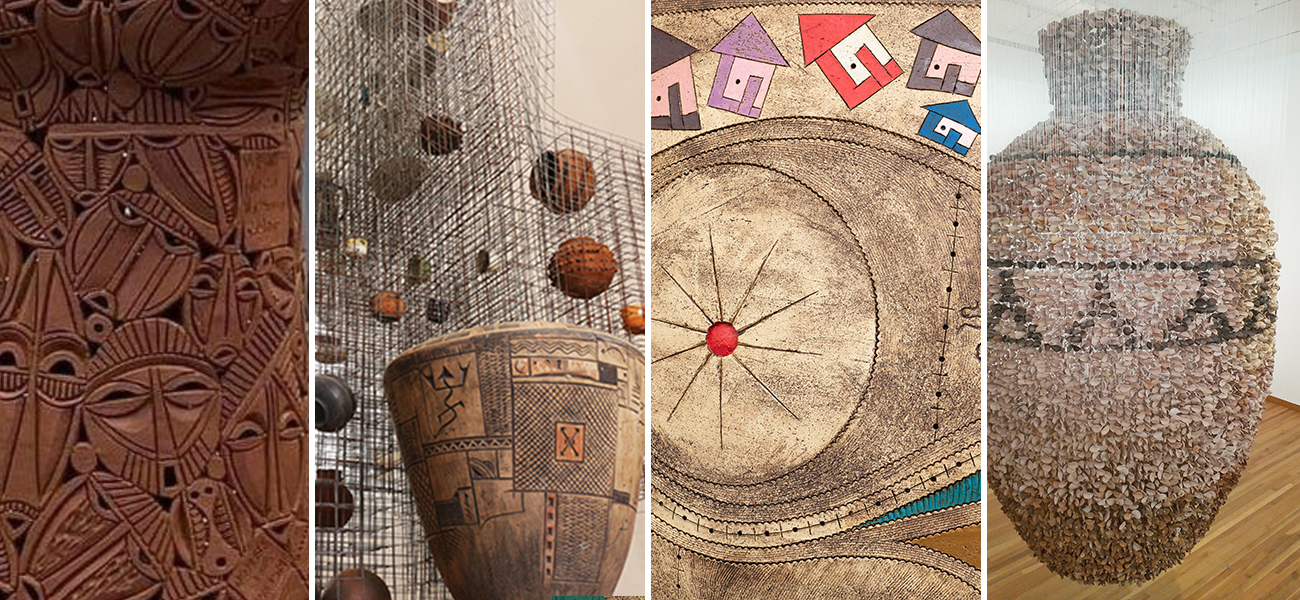
African Ceramic Art: Scale and Surface
In the contemporary landscape of African ceramics art, the “vessel” is undergoing a radical metamorphosis, as African artists are no longer confined by the traditional dimensions of the kiln or the utilitarian expectations of the vessel. It is apparent that a new generation of artists is utilizing the clay to command space, challenge history, and articulate complex cultural identities, particularly through their exploration of scale and surface. As noted by the scholar Marla Berns in 1989, “African ceramics traditions have always been deeply embedded in social and ritual contexts.”[1] Yet, contemporary practitioners like Fred Okai, Simphiwe Mbuyunza, Djakou Kassi, and Ngozi-Omeje Ezema are pushing the medium into what the renowned author Rosalind Krauss defines as the “post-medium condition.”[2] In this state, Krauss argues that the clay is liberated from the “craft ghetto” and reborn as a site of socio-political inquiry, monumental expression, and architectural intervention.
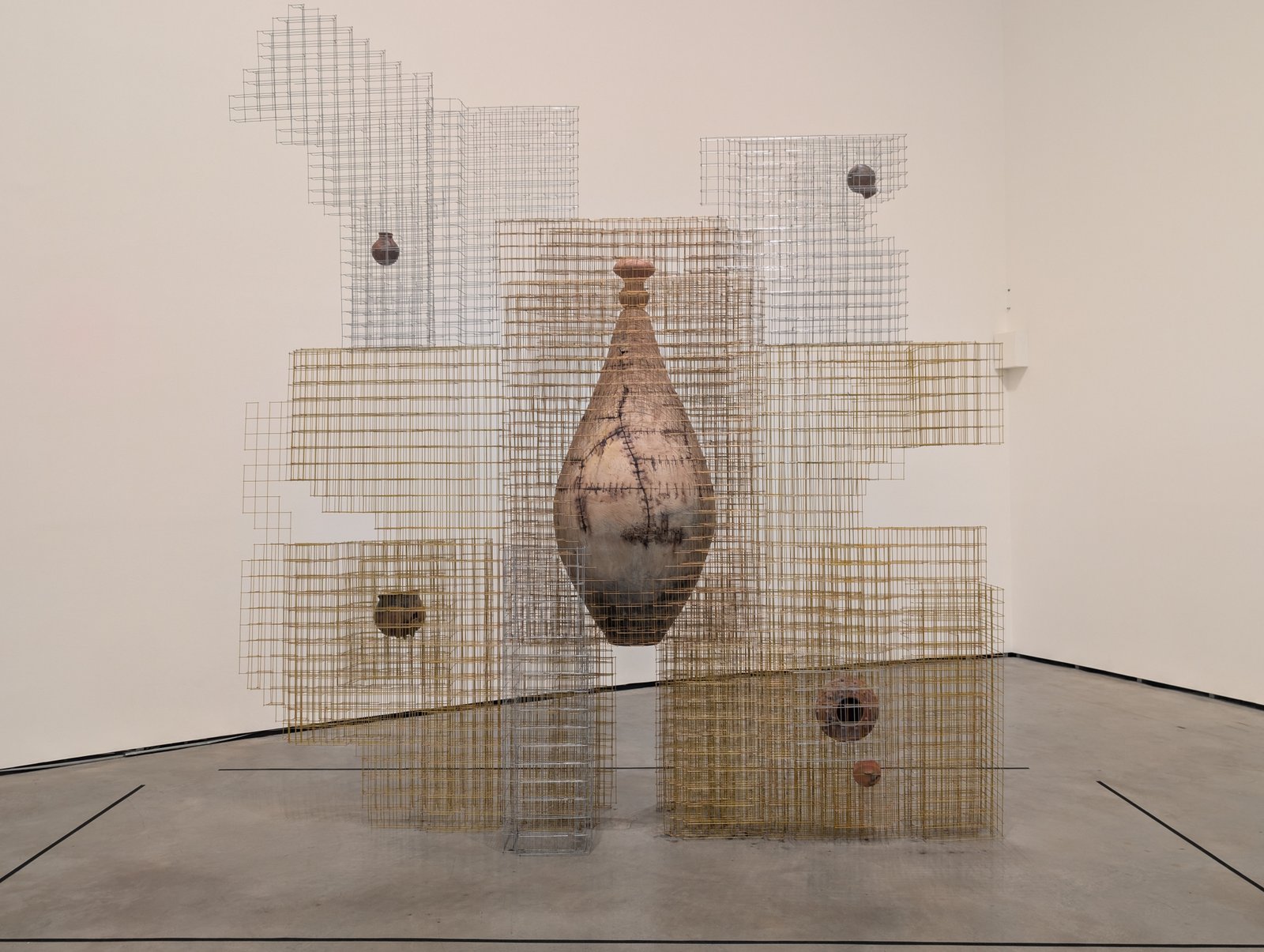
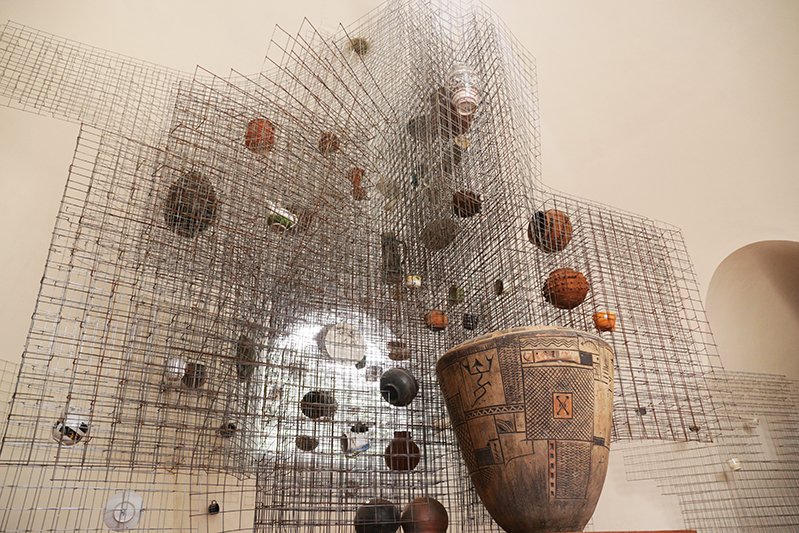 This shift begins with a reevaluation of the artist's role, transitioning into that of an archivist and a traveler. Fredrick Ebenezer Okai, based in Sunyani, Ghana, approaches the medium through the lens of a “pseudo-ethnographer.” Okai’s practice is not merely about production; it is an extensive journey into the Ghanaian repositories of knowledge, as he taps into cultural, historical, and archival materials to explore what he calls the “plastic possibilities” of clay. Here, he draws from both traditional and industrial pottery methods to reassemble ethnographic elements into site-responsive pieces that offer distinct spatial experiences. For Okai, scale is a deliberate strategy for “slow looking,” forcing a physical confrontation that echoes ethnographic material exploration. This use of scale mimics artists like Theaster Gates or Otobong Nkanga. Okai’s work is grounded in a desire to communicate honestly and accessibly by positioning his work as an open framework rather than a fixed statement. This creates a space for reflection as viewers confront their own assumptions and lived experiences. The surfaces of his forms are mostly shaped through the processes of breaking, welding, stacking, and stitching, which also serve as a “silent witness” to the past. His technical rigor moves beyond aesthetics, functioning as a method for forging new knowledge from familiar imagery. In reassembling ethnographic elements into site-responsive pieces, Okai creates what Foucault famously termed a “heterotopia,” a real, physical space that functions as an other world.[3] Unlike a utopia, which is an imaginary or perfect place, a heterotopia is a tangible site that mirrors, inverts, or contests the spaces we inhabit in everyday life. For Okai, the gallery becomes a heterotopia where the rules of the modern world are suspended, allowing ancient Ghanaian pottery traditions and contemporary digital realities to occupy the same physical coordinate. In this other space, the clay vessel is no longer a domestic tool but a witness that contests the erasure of indigenous history.
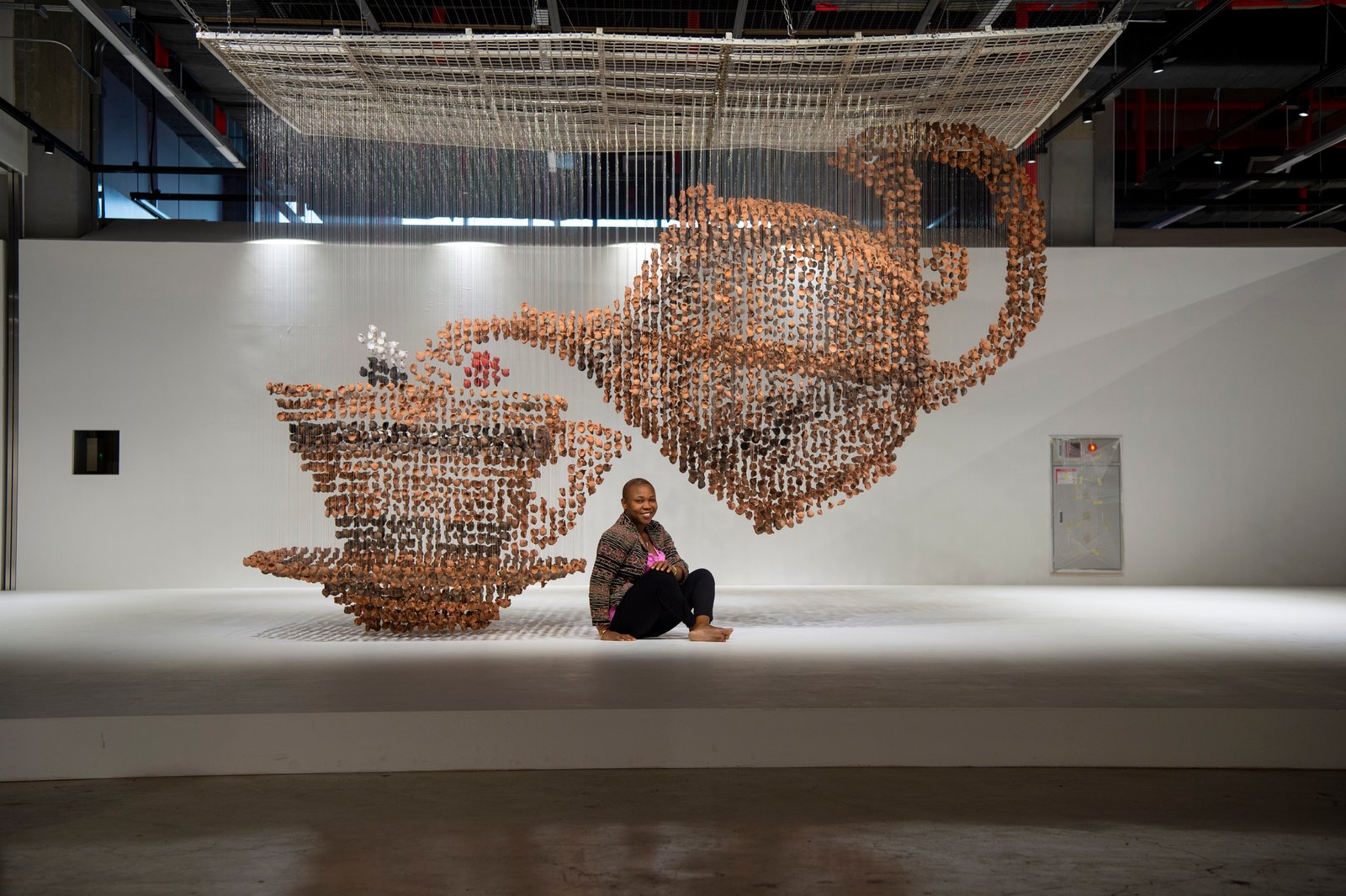
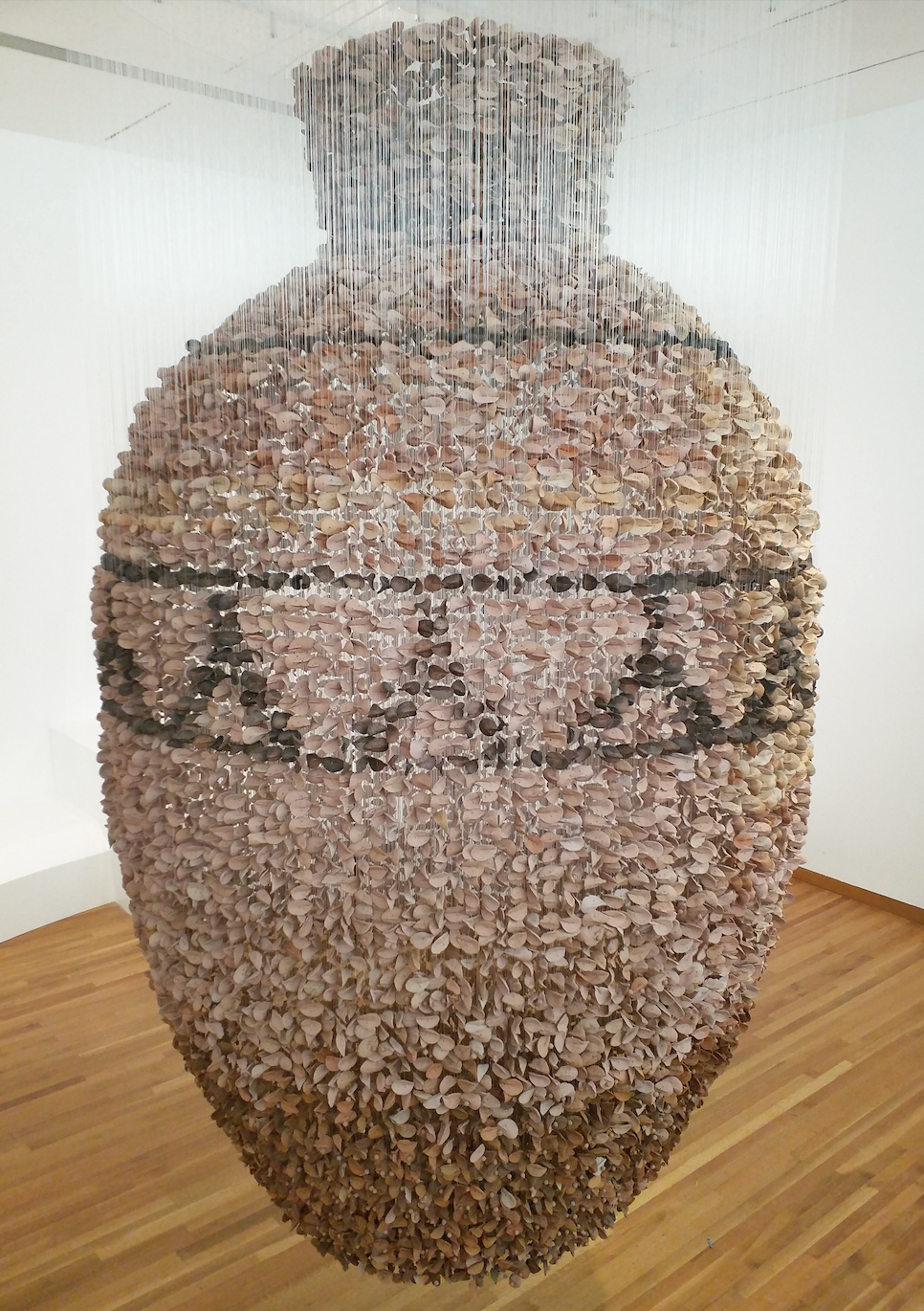 Although Okai’s practice seeks to ground his viewers through the substantial mass and ethnographic weight of his site-responsive monuments, the works of Ngozi-Omeje Ezema in Nigeria offer a radical counter-perspective as the expansion of the vessel through the deconstructed void. Ezema's work addresses the structural and inherited limitations of the ceramic medium through a revolutionary process of “deconstruction and assemblage.” Historically, in West African pottery, the size of a ceramic piece has always been dictated by the potter’s physical reach and the internal volume of the kiln.[4] The vessel had always been a singular, or enclosed, unit or entity. Ezema works by subverting these limitations by pixelating the vessel walls into thousands of individual clay units and suspending them in space by wires or thread, which she fires to a temperature of about 1,100 degrees Celsius. Ezema’s vessels suspend in space to create a sense of “weightless monumentality.” This technique allows her to occupy vast gallery spaces that would be impossible for a traditional single-fired vessel.
Ezema often inscribes her surfaces with Uli and Nsibidi motifs, an ancient graphic system of the Igbo people. These designs are traditionally used in body art and wall painting, and she has repurposed them to address contemporary gender prejudice. In her seminal work titled Togetherness, Ezema uses smoked clay leaves in dark carbonized hues to create triangular forms with linking hands, which she uses to represent female figures and discuss shared experiences with the power of joint forces against social bias. In dissolving the solid wall of the pot, Ezema achieves a multiplicity that mirrors the resilient nature of the indigenous Igbo woman. In effect, her work points to the fact that a vessel can exist as a cloud of information rather than a solid object, transforming the fragility of clay into a metaphor for human grit and communal strength.
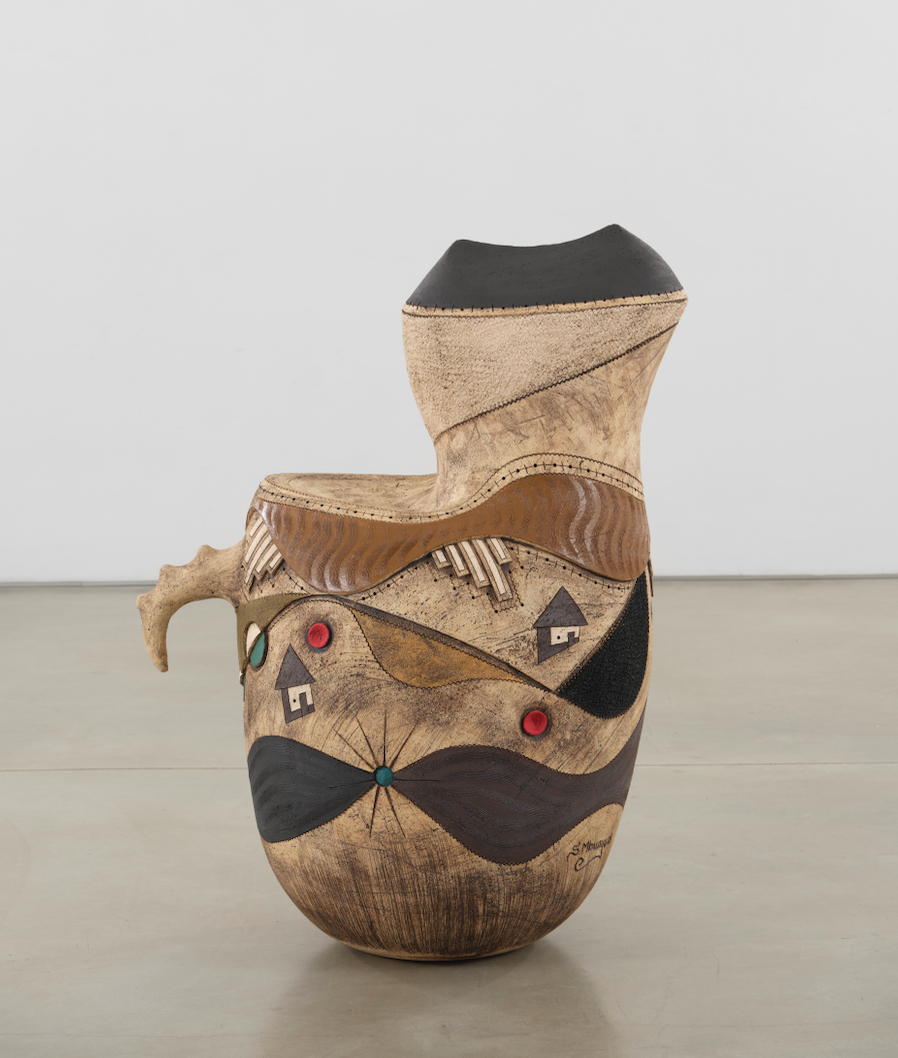
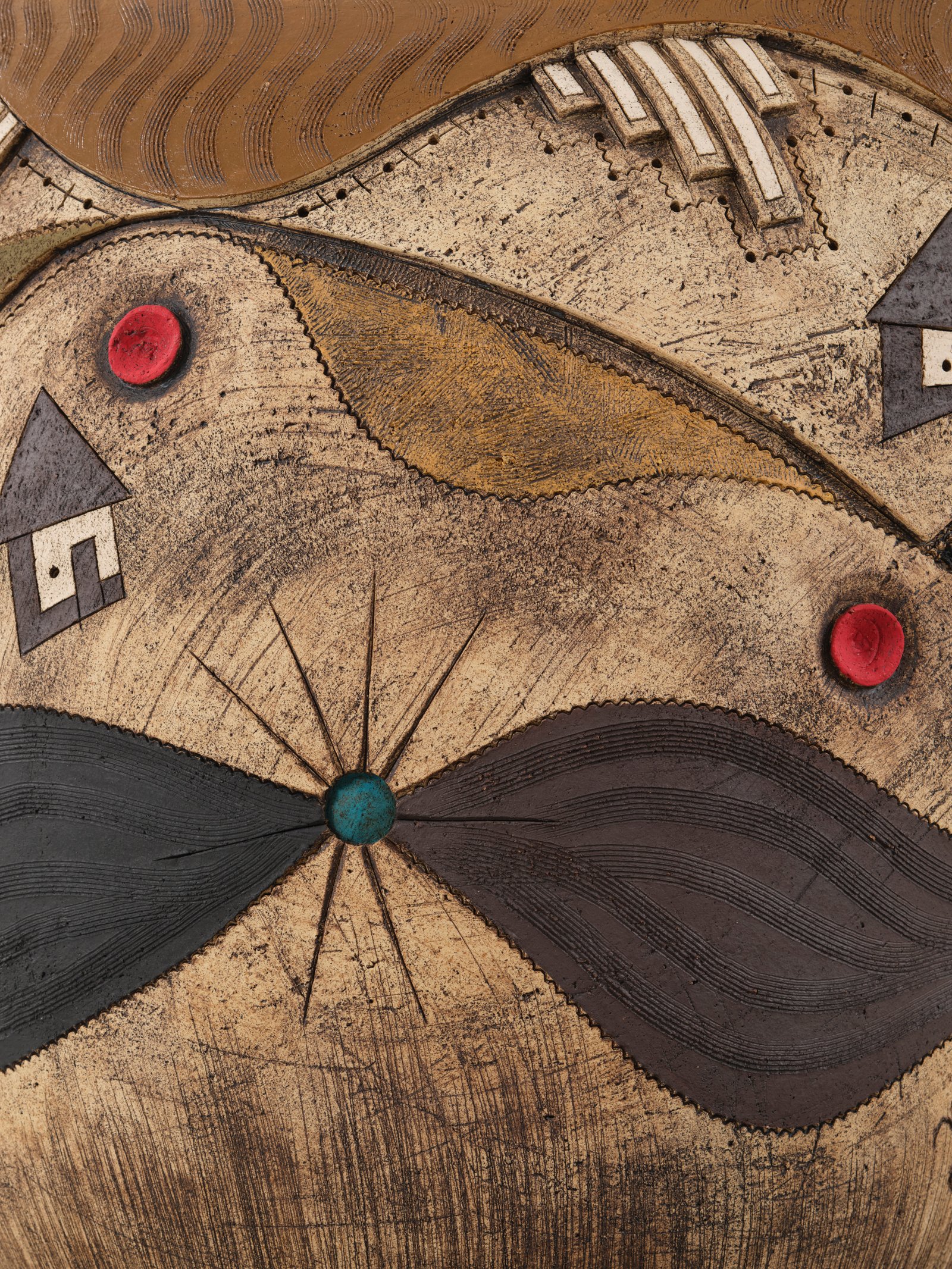
In contrast to Ezema’s deconstructed vessels, the focus on the collective and ancestral finds a different material expression as we move south to the work of Simphiwe Mbunyuza. Mbunyuza uses the density and texture of clay bodies to document the rituals and physical typographies of the Xhosa people of the Eastern Cape, South Africa. His large-scale figural sculptures function as a palimpsest of his native land by documenting and gathering where divine healers invoke the ancestors through song, dance, and drums. When creating the surfaces of his vessels, he uses repetitive marks with oxides that create distinct yellows, oranges, and blues. This wash technique mimics imbhola, the botanically produced pigments used by Xhosa women for facial marking. This process intends to connect the skin of the sculpture directly to the skin of the earth, a concept central to the study of Southern African material culture.[5]
Mbunyuza utilizes almost every bit of his sculpture’s surface to recreate cultural scenes, from line drawings of rural homes to rippled grasses viewed from an aerial perspective. His work utilizes material synecdoche, where breast-like protrusions or the imbhokodo – an oval grinding stone – represent the broader strength of Xhosa women. By working at a life-size scale, Mbunyuza transforms these cultural signifiers into monumental sentinels of memory. The scale of his work ensures that the domestic tools and rituals of Xhosa life are elevated to the status of high-art monuments, grounding the viewer in a landscape that is both physically present and spiritually ancient.

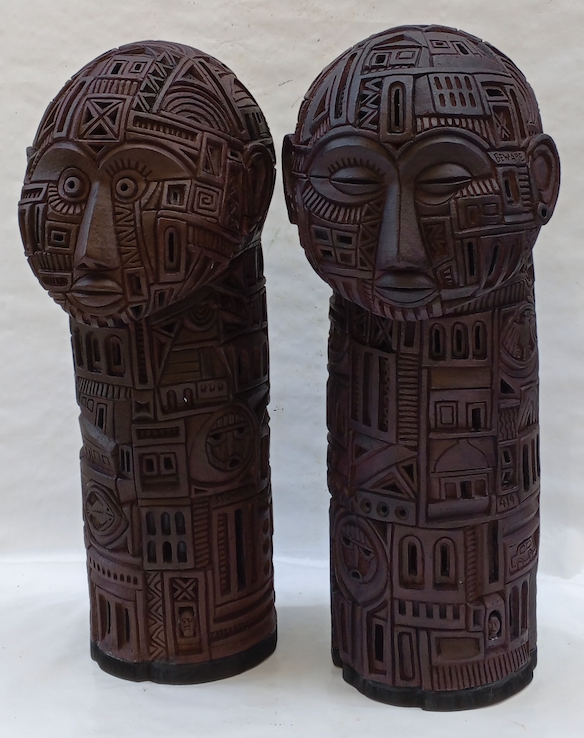
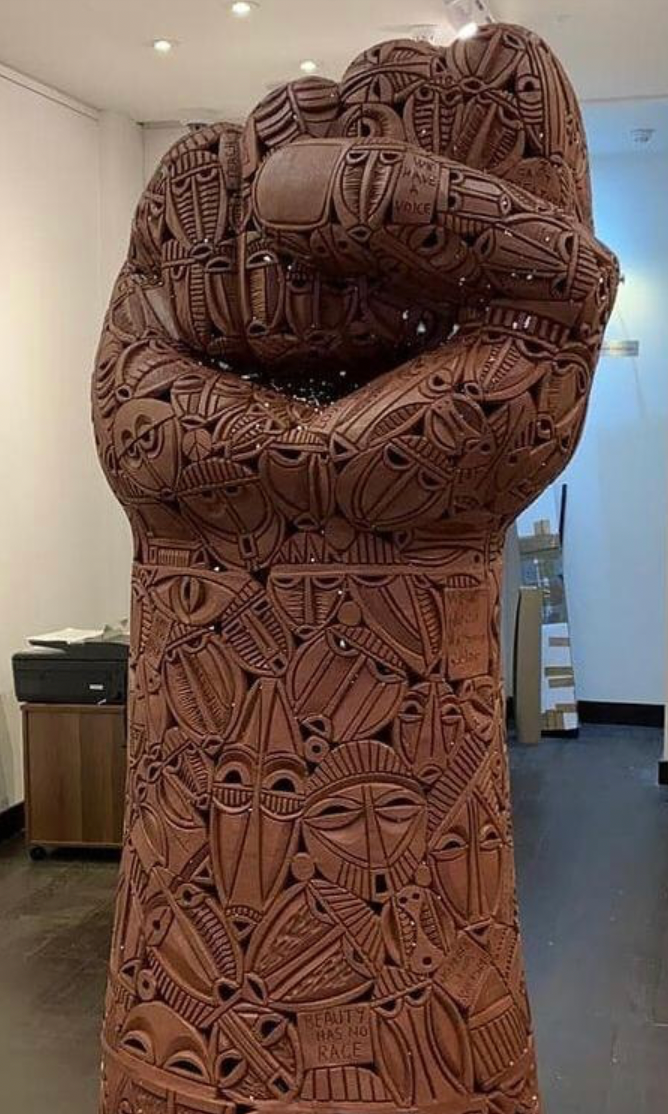
Just as Mbunyuza’s surfaces recreate regional iconographies, the work of Djakou Kanyuo from Cameroon treats ceramic forms as an architectural vessel for the human mind and the global conscience. Her practice represents the peak of surface as narrative, where the clay skin is treated as a complex, carved relief. In Kanyuo’s Shapes of Memories series, large-scale heads are adorned with intricate architectural carvings, symbolizing the layered nature of human identity. These heads serve as vessels for accumulated memories, suggesting that our recollections are the structures upon which our identities are built. Her practice demonstrates the medium’s ability for a radical social commentary. She draws inspiration from the global climate, specifically responding to the murder of George Floyd and the systemic racism that has persisted for centuries in Western nations. Her large-scale sculptures of clenched fists, intricately carved with numerous masks and placards, serve as a poignant clarion call for the idea of pushing love and fostering unity.
Kanyuo’s Bamileke heritage and the culinary tradition of cooking beans in leaf wrappers inspire her to use scale to evoke warmth and community. Kanyuo creates forms that mirror these wrappers with earthy tones and wood-smoked scents. In scaling these forms to sizes that are empowering, Kanyuo affirms that the contemporary ceramicist is not merely a maker of objects, but a vital participant in the global struggle for human recognition.
When considered collectively, these four artists reveal a shared philosophy at the intersection of scale and surface: surface functions as a narrative, while scale operates as its amplifier. As these ceramic forms approach the dimensions of the human body, they move beyond objecthood and instead assert themselves as subjects as their presence confronts, addresses, and implicates the viewer. In this transitory process from vessels to monumental sculptures, contemporary African ceramics represent not merely an aesthetic development, but a deliberate political gesture. These artists evoke a provocative scale that compels any viewer to engage with the work, while the surface allows the viewer to connect deeply with its underlying statement. African ceramic art is not static but rather a dynamic and evolving discourse. More importantly, it continues to reveal how traditions can be mobilized as a site for critical inquiry and cultural negotiations. In so doing, these artists, namely Fred Okai, Simphiwe Mbuyunza, Djakou Kassi, and Ngozi-Omeje Ezema, establish the medium as something that is capable of sustaining a complex dialogue between the artist and audience.
NOTES
[1] M. C. Berns, “Ceramic Arts in Africa,” African Arts 22, no. 2 (1989): 32–36, https://www.africaandbeyond.com/african-arts-magazine-february-1989-details.html.
[2] Rosalind Krauss, "A Voyage on the North Sea: Art in the Age of the Post-Medium Condition" (London: Thames & Hudson, 1999), https://share.google/3SAqhTSC2SUbU8JoA.
[3] Michel Foucault, “Of Other Spaces,” Diacritics 16, no. 1 (1986): 22–27, https://doi.org/10.2307/464648.
[4] Babatunde Lawal, "The Gèlèdé Spectacle: Art, Gender, and Social Harmony in an African Culture" (Seattle: University of Washington Press, 1996), https://uwapress.uw.edu/book/9780295975993/the-gelede-spectacle/.
[5] S. J. Saitowitz and D. E. Miller, “Materials Analysis of Archaeological Ceramics in Southern Africa,” The South African Archaeological Bulletin 46, no. 153 (1991): 12–18, https://www.semanticscholar.org/paper/Materials-Analysis-of-Archaeological-Ceramics-in-Miller/6f579b829923b3f519daa90a577b1349ea7284b8.