

Comics and Conscience: The Roots of Richard Notkin’s Activist Art
 In 1970 – having recently completed a BFA in ceramics at the Kansas City Art Institute (KCAI) and already grown weary of a precarious career supplying the local hippie market with handmade ceramic pipes – the twenty-one-year-old Richard Notkin contemplated attending graduate school. Deciding where to apply would not be a simple matter of identifying the most respected programs or even determining which might provide the strongest foundation for a successful career. The choice, as he understood it, would have profound consequences for the future of his art. In 1969, KCAI had played host to the fourth annual conference of the National Council on Education for the Ceramic Arts (NCECA), and, in collaboration with KCAI and NCECA, the William Rockhill Nelson Gallery (now the Nelson-Atkins Museum of Art) had concurrently mounted the invitational First National Ceramic Art Exhibition. Among the array of inspiring works by such prominent figures as Paul Soldner, Jim Leedy, Jim Melchert, Robert Arneson, David Gilhooly, Howard Kottler, Michael Frimkiss, Patti Warashina, Toshiko Takaezu, and Robert Turner, Notkin had recognized the evidence of distinctly divergent modernist currents. Selecting a graduate program, he realized, would effectively align his work with one of these.
The first, and arguably easiest, option would have been to avail himself of the pipeline constructed by professors Ken Ferguson and Victor Babu to convey the most promising KCAI graduates to their alma mater, the New York State School of Ceramics at Alfred University. Commitment to the utmost in craftsmanship, a cornerstone of Notkin’s art then as now, was unquestionable in the work of Alfred mainstays Robert Turner and Val Cushing, whose masterfully understated vessels exemplified the modernist project of extracting universal form from such historical exemplars as ancient Greek, mingei, and Song pottery. Despite his admiration for these luminaries and some apprehension that he might offend his KCAI mentors, Notkin peremptorily eliminated Alfred’s program from consideration. Among the works in the First National Ceramic Art Exhibition, West Coast ceramics and their spirit of rebellion had seized his imagination. In fact, so strong was his desire to integrate himself into the revolution in clay that he applied exclusively to the graduate programs at The University of California, Berkeley, where Peter Voulkos was popularizing the raw, gestural aesthetic of Abstract Expressionism, and The University of California, Davis, where Robert Arneson and a cadre of other rebels including Roy De Forest, William T. Wiley, and Manuel Neri had converted the department into a hotbed of Funk art. The fact that Notkin, who was accepted by both programs, chose to enroll in the latter hints at the aspirations he held for his work but also provides a glimpse backward to the importance of two foundational influences that by 1970 were just beginning to assert themselves in his art. Notkin’s work has never been autobiographical, and the pursuit of cause-and-effect relationships between biography and art may be as apt to overstate influences as to illuminate them. However, given the emphasis that Notkin himself places on these early influences and the degree to which hints of their impact remain prominent in his art today, discussion of them as determinants seems more than justifiable.
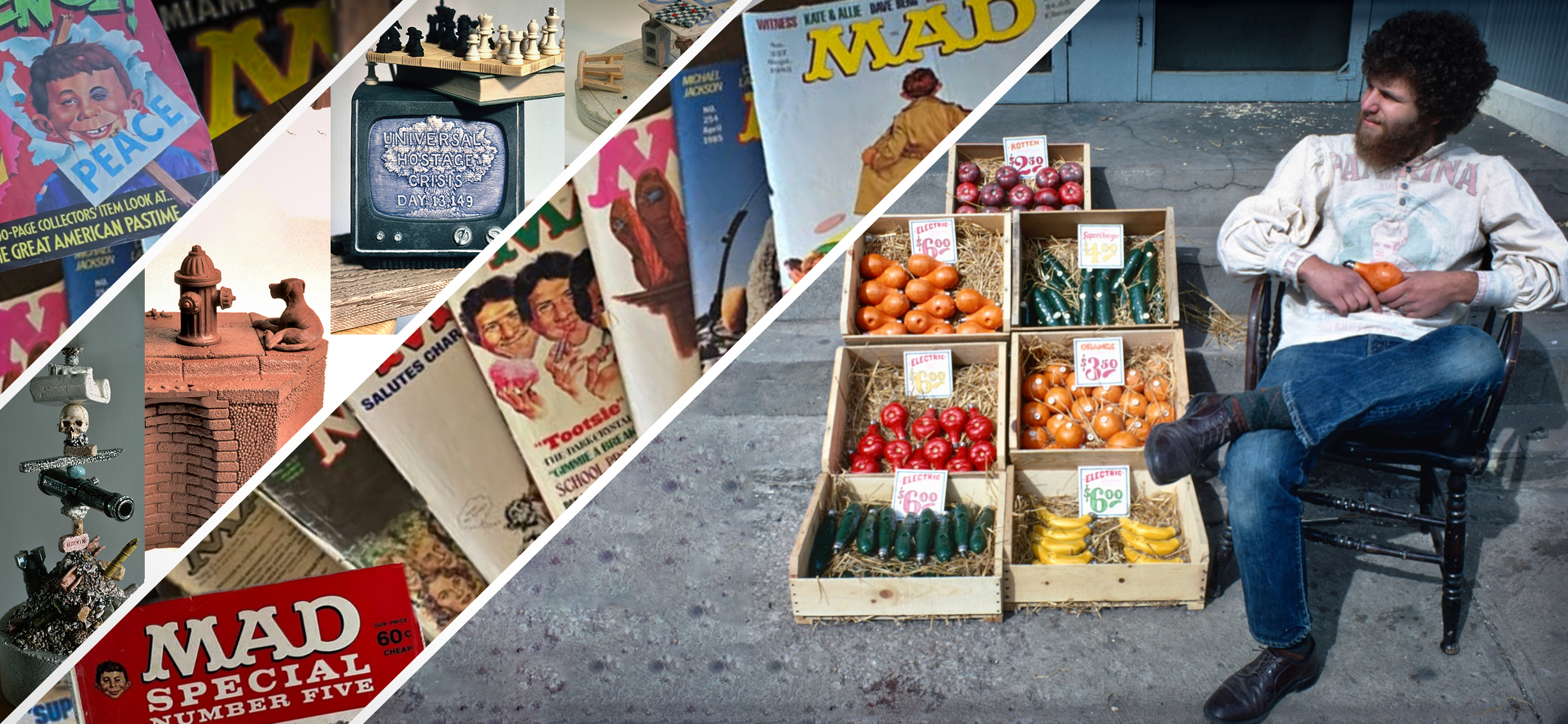
Prowess as an artist and the inclination to make it central to his identity revealed themselves early in Notkin’s life. In childhood on the South Side of Chicago, he showed a natural affinity for drawing, painting, and creating complex Tinkertoy and Erector-Set structures and enjoyed a reputation as the class artist from kindergarten onward. When he reached the second grade, his parents supported his interests by enrolling him in Saturday morning youth classes at the Chicago Art Institute, where he had the opportunity to acquaint himself with the world-class array of historical masterpieces in the museum’s galleries. Although at the time he had no inkling of their relevance to his future career, the substantial collections of pre-Columbian and Native American pottery at the Field Museum and the extensive catalog of Egyptian, Mesopotamian, Anatolian, Persian, and Levantine pottery at the Oriental Institute Museum at the University of Chicago were also situated within easy reach. Closest of all was his father’s collection of twentieth-century Chinese enameled porcelains, carved ivories, fine silk embroideries, and lacquerware: all gifts from grateful beneficiaries of Nathan Notkin’s work as an immigration attorney. Later, at the William Rockhill Nelson Gallery/Nelson-Atkins Museum of Art, when his commitment to ceramics had fully concretized through a change of majors at KCAI from painting to sculpture and ultimately to ceramics, Notkin would be dazzled by the displays of Chinese art (among them superb examples of Han and Tang tomb sculpture, Song celadons, and a small but significant group of Yixing teapots), and the vast Burnap collection of English pottery and porcelain. Arguably, however, none of these resources, impressive as they were, would exert as fundamental an influence over his later art as MAD Magazine.
 .
. 
An adolescent aficionado, Notkin owned nearly every issue of MAD and pored over them all, eventually as much for inspiration for his own drawings as out of appreciation of the images and textual buffoonery in themselves. Among the periodical’s gifted cartoonists, Don Martin, billed as “Mad’s Maddest Artist,” was a particular favorite. Martin’s repertoire of bulbous schnozzes, dimpled W chins, slack-lidded eyes, and lumpy midriffs would work its way into Notkin’s teenage drawings for a time, but the deep and lasting influence of MAD had little to do with pictorial style. After all, almost none of Notkin’s mature work has included figural elements, and few of those rare occurrences (principally dogs and skulls) bear any resemblance to the lineaments of a Fester Bestertester or Captain Klutz. Rather, the enduring effect of his childhood immersion in the zany world of MAD has been an attitude best characterized as an unflinching, even chip-on-the-shoulder skepticism toward institutional authority. A variant of this attitude, distinguished by its orientation toward specific issues and contexts, would manifest itself unequivocally in 1969 in a personally risky act (the return of his draft card to the Selective Service System), a gesture of protest against what he perceived as unjust American military intervention in Vietnam. Later, his refusal to accept official narratives backing Cold War brinksmanship would give rise to the criticism of nuclear weapons proliferation that has characterized the iconography of much of his work since the days of the Reagan administration. Another, more broadly philosophical, aspect of his skepticism – perhaps most closely represented by his images of human brains exposed in open crania or precariously situated on unstable plates – has less to do with institutions and the pressures they exert on individuals to conform to herd behavior than with doubt about the ability of humanity to learn from its tragic mistakes and so avoid the dire consequences. In the face of that exasperating folly, sometimes there is no possible response but to match absurdity with absurdity – a skill at which MAD Magazine was adept.
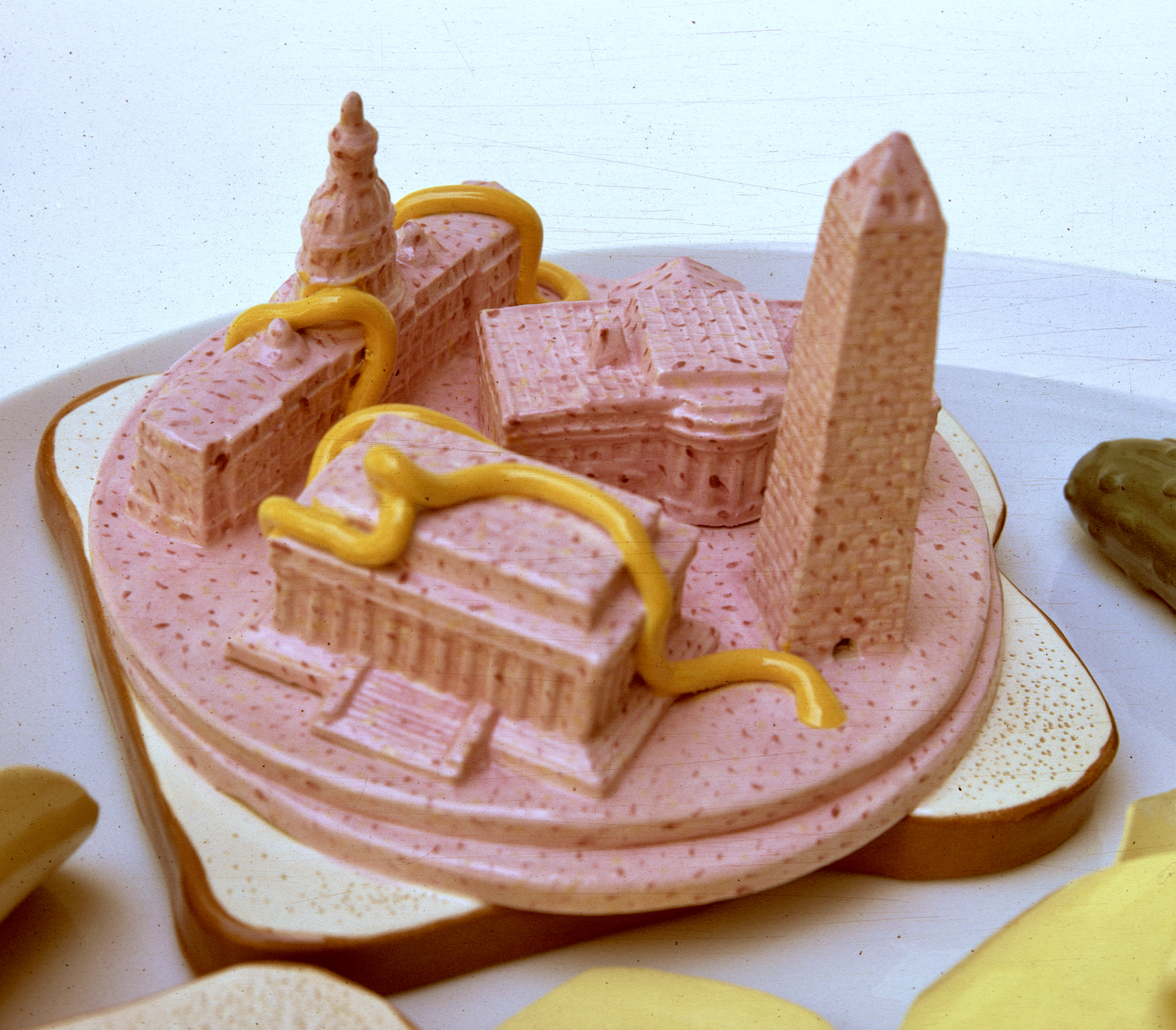
Notkin’s early enthusiasm for MAD’s mockery of authority seems an obvious presaging of his preference for the anti-establishment nose-thumbing of Arneson’s clay puns over the self-interrogatory, risk-and-will ruggedness of Voulkos’s Stacks or the almost antithetical meditative stillness of Turner’s vessels – hence, his choice to pursue an MFA at UC Davis rather than UC Berkeley or Alfred. Perhaps more important than the rebelliousness of Arneson’s work, however, was the simple fact that it was representational. Notkin had shown an affinity for representational ceramics since his first KCAI experiments in clay, a set of loosely rendered oversized toothbrushes, but gags were not all that was on his mind. In 1970, still flushed with success from his recruitment of student marchers for the November 1969 Moratorium to End the War in Vietnam demonstration in Washington, D.C., he must surely have sensed the potential to employ representation in his art in the service of his deep-seated commitment to peace. This commitment, like Notkin’s skepticism toward authority, was a product of his youth; the seeds of both his advocacy of pacifism and his enthusiasm for activism had germinated in the liberal and progressive ground of his family’s Reform Judaism synagogue.
 Although he identifies as a non-practicing Jew, Notkin stresses that the experience of attending youth programs at the synagogue exposed him to far more than religious teachings. In the 1950s, the horrors of the Holocaust were still brutally fresh, and more than one arm in his congregation bore the tattooed number of a death camp survivor. On an annual Holocaust Remembrance Day, the synagogue screened films of the camps in implicit exhortation never to forget. However, the most powerful message that Notkin absorbed, imparted by a survivor of Auschwitz, was an admonition against complacency. The Jews of Germany, she stressed, had made the fatal mistake of believing that the unthinkable couldn’t happen there, that a society grounded in the rational legacy of the Enlightenment was incapable of descending so precipitously into the barbarity that became reality. “She taught us something that I say all the time to students,” Notkin recalls. “Be alert, be aware, and be active. It’s the only way that people can stop this kind of madness.”[1] The message resonated among a congregation that embraced the doctrine of tikkun olam – literally, “repairing the world,” and in the practice of contemporary Reform Judaism, implying commitment to bettering the world through advancement of social justice. From a notably early age, Notkin adopted this doctrine as a motivational force in his life. Perhaps it was inevitable that the spirit of tikkun olam should eventually exert itself in his art as well.
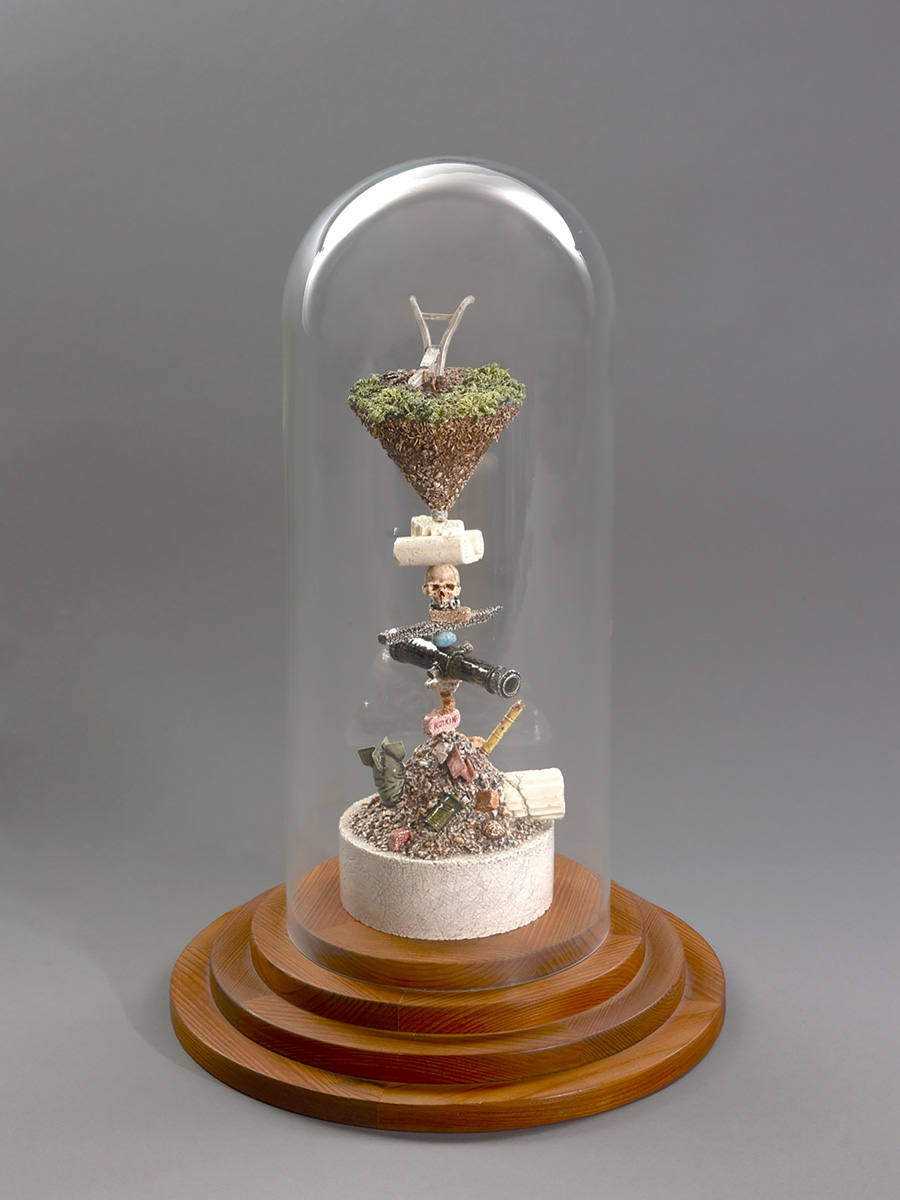
 While the doctrine was arguably already at work in 1970, whispering its words of persuasion over his decision to take the representational route at UC Davis the following year, its first true flowering would come shortly after graduation in the 1974 diminutive sculpture And They Shall Beat Their Swords into Plowshares, a marvelously intricate work, now in the Collection of the Everson Museum of Art. Notkin still counts it as among his best. Remarkably, the sculpture anticipates nearly every technical, iconographic, and compositional aspect of the art that he would produce for the next fifty years – all while, like a Janus herm, looking simultaneously backward to two of the most significant influences from his childhood and adolescence. On its base of bricks, concrete rubble, an unexploded bomb, and a broken Ionic column, the impossibly tottering tower of detritus, including a prognostic skull and cannon barrel, reminisces gleefully over the pages of MAD Magazine, where so many presumptions of civilization fell to ruin in comic heaps, while the lofty plow, embodying the precarious position that peace has always occupied in the world, simultaneously assumes the exalted nature of an ideal and advocates tacitly for Notkin’s adopted credo of eternal vigilance: “be alert, be aware, and be active.”
Notes
[1] Richard Notkin, personal interview, Oct 14, 2024.